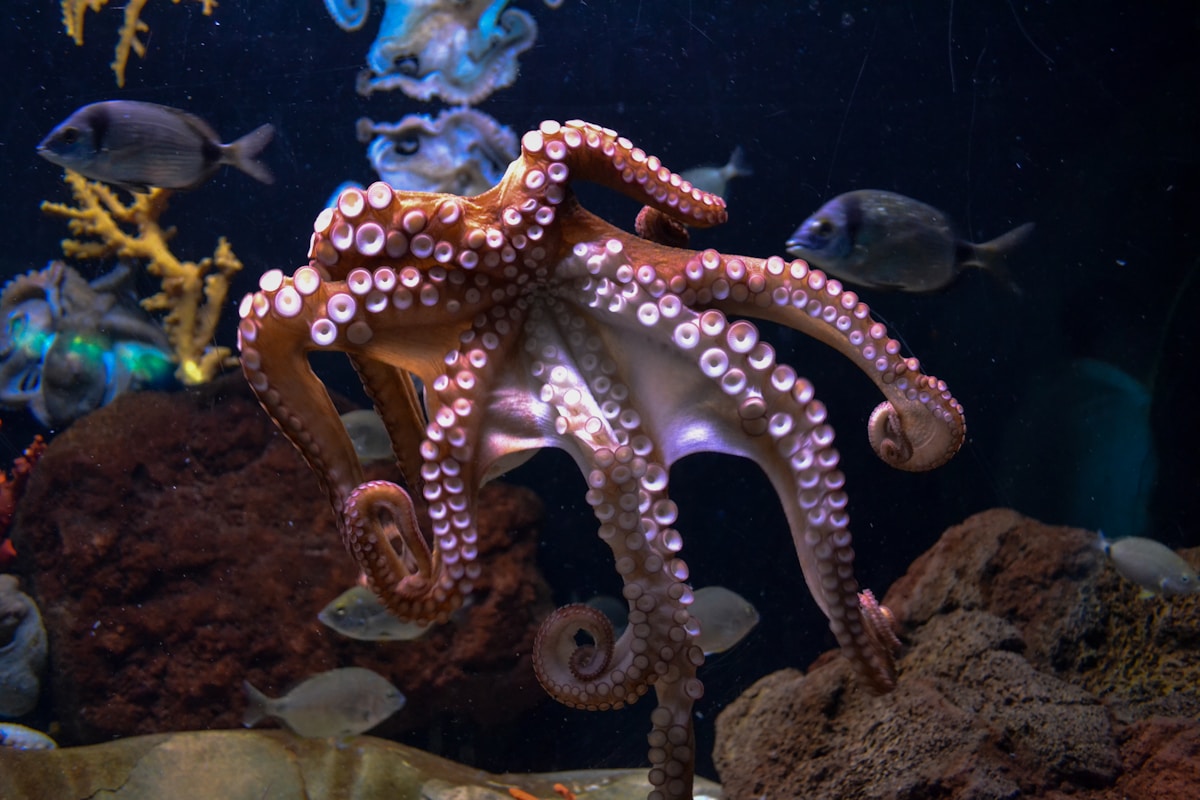
If you want to feel humbled by nature, spend some time reading about octopuses.
A Brain Like No Other
Octopuses have around 500 million neurons—comparable to a dog. But here's the wild part: only about one-third of those neurons are in their central brain. The rest are distributed throughout their eight arms, which can taste, touch, and essentially "think" independently.
Each arm can solve problems on its own. In experiments, a severed octopus arm will still reach for food and try to bring it to where the mouth would be. The arm doesn't know the body is gone.
Tool Users of the Sea
Octopuses have been observed:
- Carrying coconut shells to use as portable shelters
- Stacking rocks to fortify their dens
- Unscrewing jars from the inside to escape
- Squirting water at lab equipment they find annoying (yes, really)
One octopus at the University of Otago learned to turn off the lights in her tank by squirting water at the bulb. She did it repeatedly. The staff gave up and moved her.
Do They Dream?
Recent research from Brazil captured octopuses cycling through color and texture changes while sleeping—patterns that look remarkably like the stages of sleep in mammals. Their skin flickered through camouflage patterns as if replaying the day's events.
We can't prove they dream, but something is happening in there.
The Lonely Genius
Here's the melancholy part: octopuses are solitary and short-lived. Most species die after reproducing, living only 1-2 years. Mothers guard their eggs without eating, often for months, and die shortly after the eggs hatch.
They don't pass knowledge to their young. Every octopus starts from scratch, figuring out the world alone. Despite this, they've evolved remarkable intelligence independently from vertebrates—a completely separate experiment in how brains can work.
Why It Matters
Octopuses challenge our assumptions about what intelligence requires. No social learning, no long lifespan, no parental guidance—and yet they solve novel problems, recognize individual humans, and appear to have preferences and personalities.
It suggests that consciousness and problem-solving aren't unique to our branch of the tree of life. The universe might be full of minds we wouldn't recognize.
Sources: Scientific American, Nature, University of Otago research archives